Pages

Sunday, February 9, 2014

RWA# 1: Unit M Concept 5: Graphing Ellipses Given Equations and Defining All Parts

1. Definition:The set of all points such that the sum of the distance of two points known as the foci is a constant. (Mrs. Kirch).

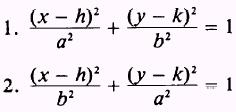
2.


                                        .


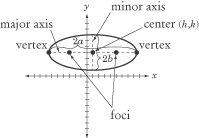
                   An ellipse usually looks like a squished circle.  The equation for an ellipse is shown above. The ellipse consist of a center, major axis, minor axis, vertices, co-vertices,and foci. The center is a point inside the ellipse.
                  We can find the center by h,k. If we look at the equation we'll see that h will always go with x and y will always go with k. But we have to make sure we put it in h,k format. The major and minor axis intersect and go through the center. To find  if the major axis  is horizontal or vertical , we have to look at the standard form of the equation. It will be horizontal if the larger denominator is under the x^2 term and this means the ellipse will be fat. If  the larger term is under the y^2 the major axis will vertical and skinny. The major axis can be demonstrated on the graph with a solid line and the minor with a dashed line. The vertex is two points at the end of the major axis. They can be found by it being "a" distance from a to the center. The two co-vertices are the end points of the minor axis. The co-vertices can be found by it being "b" distance from the ellipse. You count from the center.  To plot the foci you must plot c units to the left/ right if x^2 has the larger value below  it. Move and plot c units up/down if y^2 has the bigger number under it. To find any values for a, b, or c that aren't given use the formula a^2-b^2=c^2.  Eccentricity must be between 0 and 1.  This can be found  by dividing c over a and rounding it three decimal places. For more information look at this website. (http://www.mathsisfun.com/geometry/ellipse.html)

3. Real World Application


             Ellipses can be seen in our solar systems.. Although some objects follow circular orbits, most orbits are shaped more like "stretched out" circles or ovals.(http://www.windows2universe.org) Since the orbit of Earth around the Sun is very circular the eccentricity is very close to one. Like we can see in the video the foci of the solar system lies in the sun.
           All planets have a different distance from the center because the planets are all spread around and not in a straight line. If we take a look  the earth and the sun we can see that since the foci are together the and that is the reason why the Earth seems to revolve in a circle around the sun. The actual eccentricity is .0167. The major axis in the solar system would be the from the Earth to the sun and that same distance to the left/right.
        

4. References:

Monday, December 9, 2013

SP 6: Unit K Concept 10: Writing a Repeating Decimal as a Rational Number Using Geometric Series


     The viewer needs to pay attention to finding the ratio by dividing the second term by the first. Additionally, when dividing the numerator by a fraction, multiply the top and bottom by its reciprocal. It is crucial to remember the whole number 2 at the beginning of the problem. Add it to the solution by multiplying top and bottom by 99 to get the same denominator and then add the two.

Sunday, November 24, 2013

Fibonacci Haiku: Heels


Heels
Fabulous
I love them
Wouldn't change them for anything 
Wear them and you grow a few inches


Monday, November 18, 2013

SP # 5 Unit J Concept 6: Partial Fraction Decomposition with Fractions


     Please pay special attention to how  I got a, b& c. Look closely to how I checked my answer. How I got  my matrices. As well as where I got my equations and how i got the same denominator but different numerator. And what I did after. 
    

SP #4 - Unit J Concept 5: Partial Fraction Decomposition with distinct factors


     For the first picture 1,special attention should be payed to multiplying out the numerator. Also, be careful when distributing negative numbers, you must distribute the negative to everything in the parentheses, then combine like terms. For the second picture the viewer should be careful when writing the equations. It is important to copy correctly and not forget any negative signs. It is also crucial the viewer remembers to cancel out the x's.
      For the third picture plug in the coefficients into the calculator. It is crucial you plug in the right numbers or else you will get the wrong answer. It is important to recheck what you plugged in. Follow the necessary steps to find the ordered triple. The viewer should be able to follow the steps as stated in the image. It is important not to forget the closing parentheses! The fourth column provides the ordered triple, notice that these are the numerators of the original equation found in part 1.