Create your own Playlist on LessonPaths!
Thursday, March 6, 2014

Tuesday, March 4, 2014
I/D #2: Unit O - How can we derive the patterns for our special rights triangle?
INQUIRY ACTIVITY SUMMARY:


Then we cut straight down on the triangle and that gives us an angle of 30* on the top because since we divide it symmetrically the angle dives into two. If we were to add 30+30 we would get an answer of 60. Then we created a 90* angle on the bottom left because the line created a perpendicular angle with the bottom of the triangle. ( as shown in the first picture). Since its an equilateral angle we know that all sides are equal and in this case it has a measurement of 1 on all three sides. The bottom side is 1/2 because its half of one. To find the other side (height) we use the Pythagorean Theorem ( a^2+b^2=c^2). We plug in 1/2 for a, were looking for b, and we plug in for 1 for c. This gives us an answer of rad3/2 for b. However to make the sides easier do deal with we give all sides a variable, we will use n, and were going to give that n a value of 2n. We give it a value of two because we don't want to deal with fractions. (see picture 2) Once we have done that we get a hypotenuse of 2n a horizontal side of n, and a vertical side of n rad3. Remember n just represents any number and it keeps the relationship consistent.
2. 45-45-90 triangle


For the 45-45-90 triangle we begin with a square. A square has four equal sides and four 90* angles. (see the first picture)First we drew a diagonal which cut the 90* angle into two pieces and that left us with a 45 degree angle. Since all sides are equal the horizontal and the vertical sides are 1. Then we use the Pythagorean theorem to find c ( diagonal). We use 1 for a and b and that gives us an answer of rad2 (picture number 2) Then we add n because n represents any number and it remains the relationship consistent.
INQUIRY ACTIVITY REFLECTION
1. Something I never noticed before about right triangles is how we were able to find the ratios from the equilateral triangle and a square.
2. Being able to derive these triangles myself aids in my learning because I can understand how a special right triangle works and use this for concepts 7 and 8.
Wednesday, February 19, 2014
I/D# 1: Unit N Concept 7: The Unit Circle
- INQUIRY ACTIVITY SUMMARY

-
The first thing I did was label the triangle according to the Special Right Triangle. The hypotenuse was labeled as 2x, the horizontal side x rad3, and the vertical x. Next we had to simplify the hypotenuse to make it one. In order to do that we had to divide all three sides by 2x. As seen in the picture above we can see that when we divided x by 2x the x's canceled and it became 1/2. For the horizontal side the x's also canceled and it simplified to rad 3/2. Afterwards, I labeled the hypotenuse r, the horizontal value x, and the vertical value y. Then I drew a coordinate plane. We began by making the labeled angle side the origin (0,0). Then near the 90 angle I labeled it as ( rad3/2,0) because we moved rad 3/2 on the x axis and we didn't move any units up. The top vertices is labeled as ( rad3 /2,1/2) because we moved right rad3/2 and up 1/2.

3. Describe the 60* triangle:

This is very similar to the 30* triangle but for the 60* triangle the sides are switched. The hypotenuse still being 2x, the vertical side x radical 3, and the horizontal side as x. We first divide everything by 2x and we get a vertical side of radical 3/2, a horizontal side of 1/2, and hypotenuse of one (just like the 30* angle and after simplifying).Next we place the triangle on the first quadrant giving us ordered pairs of (1/2, radical 3\2), (1/2,0), and (0,0).
4. This activity helps me derive the unit circle because it gives me the degrees, points, and ordered pairs that are located at quadrant one of the unit circle. These three triangles are important because there reflected on the unit circle. The vertices on the top are the points used all around the circle but they have different x and y values. ( explained below)

5. The 30*,45*,and 60* triangles that we did in the activity lie on the first quadrant. Since the first quadrant is reflected on the second quadrant, the second is reflected on the third quadrant, and the third on the fourth quadrant. The values of the vertices change. In the first quadrant both values are positive, in the second quadrant the x value is negative. In the third quadrant the values of both the x and y are negative. For the fourth quadrant the y value is negative.
INQUIRY ACTIVITY REFLECTION
This activity will help me in this unit because with just knowing the ordered pairs from these three triangles, I can easily narrow down the answers for degrees that have the share reference angles.
Something I never realized before about special right triangles and the unit circle is that I can see the unit circle as triangle to find the vertices.
Sunday, February 9, 2014
RWA# 1: Unit M Concept 5: Graphing Ellipses Given Equations and Defining All Parts
1. Definition:The set of all points such that the sum of the distance of two points known as the foci is a constant. (Mrs. Kirch).
2.
.
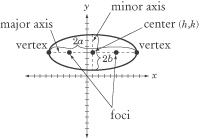
An ellipse usually looks like a squished circle. The equation for an ellipse is shown above. The ellipse consist of a center, major axis, minor axis, vertices, co-vertices,and foci. The center is a point inside the ellipse.
We can find the center by h,k. If we look at the equation we'll see that h will always go with x and y will always go with k. But we have to make sure we put it in h,k format. The major and minor axis intersect and go through the center. To find if the major axis is horizontal or vertical , we have to look at the standard form of the equation. It will be horizontal if the larger denominator is under the x^2 term and this means the ellipse will be fat. If the larger term is under the y^2 the major axis will vertical and skinny. The major axis can be demonstrated on the graph with a solid line and the minor with a dashed line. The vertex is two points at the end of the major axis. They can be found by it being "a" distance from a to the center. The two co-vertices are the end points of the minor axis. The co-vertices can be found by it being "b" distance from the ellipse. You count from the center. To plot the foci you must plot c units to the left/ right if x^2 has the larger value below it. Move and plot c units up/down if y^2 has the bigger number under it. To find any values for a, b, or c that aren't given use the formula a^2-b^2=c^2. Eccentricity must be between 0 and 1. This can be found by dividing c over a and rounding it three decimal places. For more information look at this website. (http://www.mathsisfun.com/geometry/ellipse.html)
3. Real World Application
Ellipses can be seen in our solar systems.. Although some objects follow circular orbits, most orbits are shaped more like "stretched out" circles or ovals.(http://www.windows2universe.org) Since the orbit of Earth around the Sun is very circular the eccentricity is very close to one. Like we can see in the video the foci of the solar system lies in the sun.
All planets have a different distance from the center because the planets are all spread around and not in a straight line. If we take a look the earth and the sun we can see that since the foci are together the and that is the reason why the Earth seems to revolve in a circle around the sun. The actual eccentricity is .0167. The major axis in the solar system would be the from the Earth to the sun and that same distance to the left/right.
4. References:
2.

.
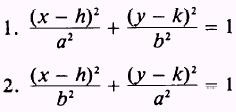
An ellipse usually looks like a squished circle. The equation for an ellipse is shown above. The ellipse consist of a center, major axis, minor axis, vertices, co-vertices,and foci. The center is a point inside the ellipse.
We can find the center by h,k. If we look at the equation we'll see that h will always go with x and y will always go with k. But we have to make sure we put it in h,k format. The major and minor axis intersect and go through the center. To find if the major axis is horizontal or vertical , we have to look at the standard form of the equation. It will be horizontal if the larger denominator is under the x^2 term and this means the ellipse will be fat. If the larger term is under the y^2 the major axis will vertical and skinny. The major axis can be demonstrated on the graph with a solid line and the minor with a dashed line. The vertex is two points at the end of the major axis. They can be found by it being "a" distance from a to the center. The two co-vertices are the end points of the minor axis. The co-vertices can be found by it being "b" distance from the ellipse. You count from the center. To plot the foci you must plot c units to the left/ right if x^2 has the larger value below it. Move and plot c units up/down if y^2 has the bigger number under it. To find any values for a, b, or c that aren't given use the formula a^2-b^2=c^2. Eccentricity must be between 0 and 1. This can be found by dividing c over a and rounding it three decimal places. For more information look at this website. (http://www.mathsisfun.com/geometry/ellipse.html)
3. Real World Application
Ellipses can be seen in our solar systems.. Although some objects follow circular orbits, most orbits are shaped more like "stretched out" circles or ovals.(http://www.windows2universe.org) Since the orbit of Earth around the Sun is very circular the eccentricity is very close to one. Like we can see in the video the foci of the solar system lies in the sun.
All planets have a different distance from the center because the planets are all spread around and not in a straight line. If we take a look the earth and the sun we can see that since the foci are together the and that is the reason why the Earth seems to revolve in a circle around the sun. The actual eccentricity is .0167. The major axis in the solar system would be the from the Earth to the sun and that same distance to the left/right.
4. References:
Monday, January 13, 2014
Thursday, December 19, 2013
WPP #9: Unit L Concept 4-8: FCP, Combinations, and Permutations
Create your own Playlist on MentorMob!
Monday, December 9, 2013
SP 6: Unit K Concept 10: Writing a Repeating Decimal as a Rational Number Using Geometric Series


The viewer needs to pay attention to finding the ratio by dividing the second term by the first. Additionally, when dividing the numerator by a fraction, multiply the top and bottom by its reciprocal. It is crucial to remember the whole number 2 at the beginning of the problem. Add it to the solution by multiplying top and bottom by 99 to get the same denominator and then add the two.
Subscribe to:
Posts (Atom)